On 22 May 1981, officers on the banks of the Chattahoochee River in Atlanta recovered the body of Nathaniel Cater. Investigators later pointed to fibres clinging to his clothing as a key link in the Atlanta child‑murders prosecution. That kind of microscopic linkage is what Lyon criminologist Edmond Locard had in mind when he argued that whenever two objects meet, material passes between them.
Locard's lab and the idea that changed crime scenes
In 1910, the police authorities in Lyon gave Locard two attic rooms in the Palais de Justice and permitted him to install what would become one of the world's first police forensic laboratories. He had trained under Alexandre Lacassagne, a pioneering criminologist, but his own conviction was stark: a person who enters a room, touches a surface or strikes a victim takes something away and leaves something behind.
In his later writings, including the multi‑volume Traité de criminalistique, Locard argued that a criminal cannot act, especially during a violent crime, without leaving traces of presence and without carrying traces of the scene away. The exchange runs in both directions. Fibres move from a sleeve to a chair, soil from a boot to a carpet, and glass from a window to a jacket. The phrase "every contact leaves a trace" is a paraphrase, but it captures the practical rule he offered detectives.
The laboratory at Lyon was modest: a few rooms under the roof, a microscope, and a small staff. Yet the procedural discipline Locard enforced still underpins crime scene work. Technicians were expected to collect and package material systematically, to compare questioned samples against known references, and to document each step in a way a magistrate could understand. The police work described in The Whitechapel Murders: What the Police Files Really Show unfolded before this kind of laboratory existed, which helps explain why conjecture rather than trace analysis dominates those files.
Locard's exchange principle does not promise that investigators will always find a trace. It makes a narrower claim: if contact occurred, some transfer happened, whether or not it is later recovered. The practical task lies in knowing where to look, how to collect the material without damaging it, and what the resulting comparisons can and cannot prove.
How traces move and why they matter
Transfer evidence appears in three broad forms. Primary transfer occurs when two surfaces touch directly: a hand on a banister, a tyre on gravel. Secondary transfer uses an intermediate: a fibre from a suspect's scarf adheres to an officer's sleeve and then to a victim's clothing. Background deposition comes from the general environment, such as urban dust settling on every surface in a room.
The amount and persistence of a trace depend on factors that can be tested. Contact force and duration affect how deeply particles embed. Surface roughness and porosity determine whether fibres catch or slide away. Environmental conditions—rain, heat, foot traffic—govern whether material remains, migrates or degrades.
A cotton fibre pressed into carpet pile behaves differently from epithelial cells left on a dry glass. Paint flakes from a car retain a layered structure that can be examined under a microscope. Glass fragments can be measured for refractive index. Each of these physical properties gives analysts a way to compare a questioned sample with a known source and to say whether they are consistent.
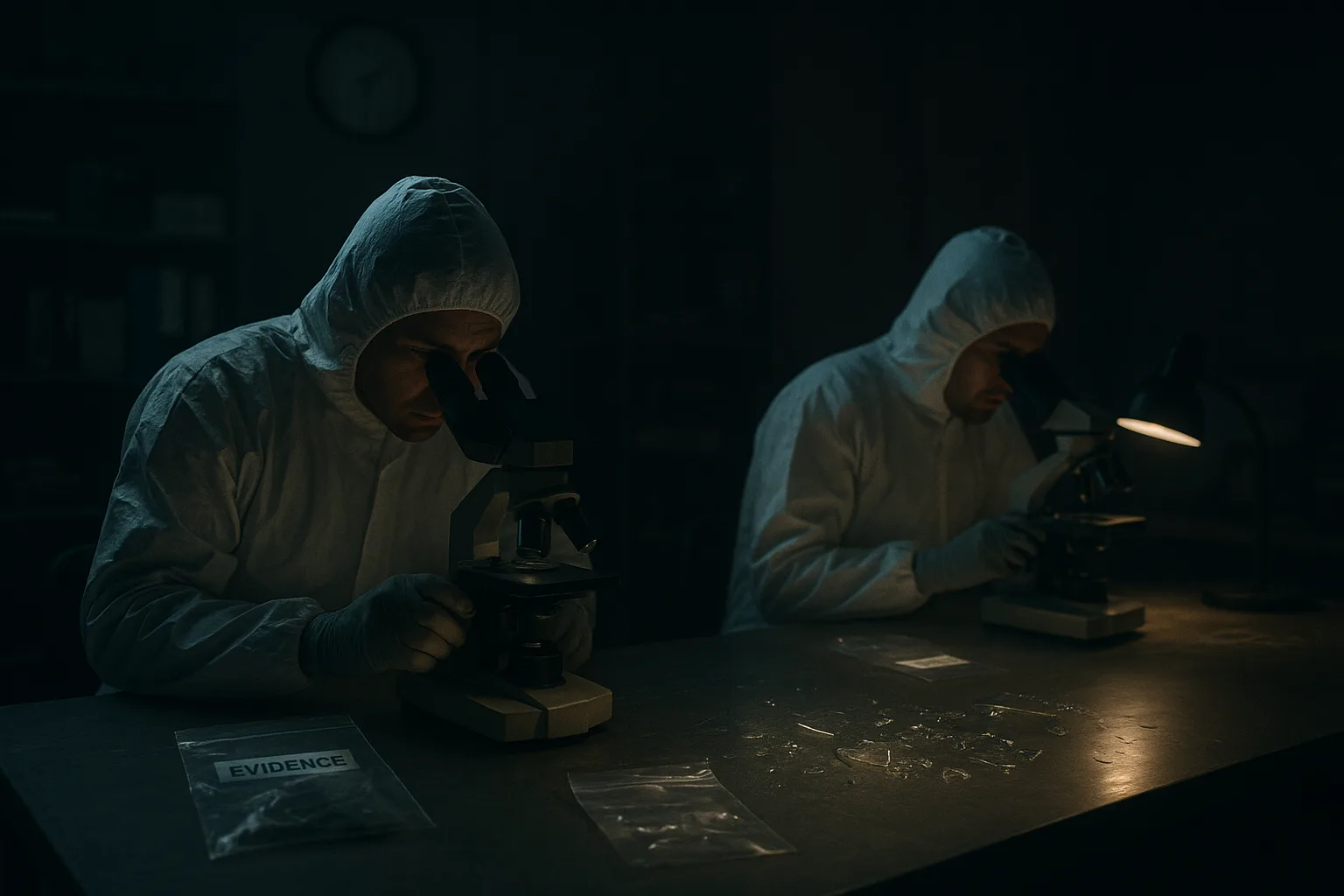
Modern forensic laboratories use a set of tools built around this logic. Comparison microscopes allow side‑by‑side examination of fibres and hairs. Gas chromatography–mass spectrometry separates and identifies chemical components in paints, explosives and residues. Scanning electron microscopy with energy‑dispersive X‑ray analysis reveals surface texture and elemental composition in metals and glass. DNA profiling techniques, from early restriction‑fragment methods to current STR analysis, extend Locard's principle to the molecular level by treating biological material as another form of trace.
Every contact leaves a trace, but a trace is only evidence once someone has the training to find it, the discipline to collect it, and the honesty to say what it proves.
Case studies where transfer decided the outcome
Fibres in the Atlanta child murders
One of the most cited examples of transfer evidence in a major American trial came from Atlanta in the early 1980s. Between 1979 and 1981, more than two dozen young Black men and boys were murdered in the city, and the investigation became one of the largest in the history of the Atlanta Police Department. Two adult victims, Nathaniel Cater and Jimmy Ray Payton, were killed in May 1981; their bodies were found in the Chattahoochee River.
Investigators recovered fibres from the victims' bodies and clothing. Forensic analysts compared those fibres with carpet and vehicle materials from the home and van of Wayne Williams, a young photographer and music promoter. Examiners testified that the fibres matched in colour, cross‑section and composition with material from Williams's residence and vehicle. Williams was convicted in 1982 of the murders of Cater and Payton.
Fibre evidence did not stand alone; the prosecution combined it with behavioural and circumstantial elements. The case nonetheless shows how a few threads of carpet, collected early and compared carefully, can become the spine of a narrative about where a victim has been and with whom they have had contact.
DNA profiling and Colin Pitchfork
Locard's principle extends beyond textiles. In Leicestershire in the 1980s, biological transfer became central forensic practice. Two 15‑year‑old girls, Lynda Mann and Dawn Ashworth, were raped and murdered in neighbouring villages in 1983 and 1986. Semen recovered from the scenes allowed University of Leicester scientists, working with Sir Alec Jeffreys's new DNA profiling technique, to test whether samples from different crimes came from the same individual.
Rather than pointing immediately to a suspect, the first round of DNA profiling excluded a man who had confessed. Police then undertook a mass voluntary screening of thousands of local men, collecting blood and saliva for analysis. Laboratory comparisons ultimately identified Colin Pitchfork as the source of the crime‑scene samples. He pleaded guilty and was sentenced to life imprisonment in 1988.
The Pitchfork case showed that Locard's exchange principle could be read at the level of genetic sequence. Biological material transferred during an assault became not just a general indicator of contact but a highly individualised marker. At the same time, the case illustrated a safeguard Locard would have approved: using the method first to eliminate a wrongful confession before it identified the offender.
Physical match in the Lindbergh kidnapping
Not every probative trace is a loose particle. In the 1932 kidnapping of the infant son of aviator Charles Lindbergh, investigators examined the homemade wooden ladder used to reach the nursery window. Wood analysis by experts linked the ladder's timber to floorboards in the attic of Bruno Richard Hauptmann.
The strength of the link did not rest on a romantic notion of "unique" wood. Examiners compared grain patterns, tool marks and composition, and argued that sections of the ladder and sections of the attic boards had once formed part of the same planks. The defence challenged that conclusion vigorously, but the physical match became a central element at trial.
Physical matches of this kind—where broken surfaces or tool marks align—remain among the most persuasive forms of transfer evidence. They show not only that material is consistent with a source but that it once formed a single object now divided between scene and suspect.
Limits, errors and the need for safeguards
Locard's principle is frequently exaggerated in popular crime dramas, where a single hair seems to name a killer with certainty. In practice, three weaknesses shape how investigators and courts should treat transfer evidence.
Persistence is the first. Many traces shed or degrade within hours. Loose fibres fall away with movement. Biological material can dry, wash or decompose. The longer the delay before a scene is secured, the more likely it is that some traces have been lost or altered.
Secondary transfer is the second. Material can move through intermediaries, so that a fibre on a victim's clothing may originate from a paramedic's jacket rather than the offender's coat. Without careful scene logs and control samples from responders, such indirect movement can be hard to untangle.
Contamination is the third. Unrestricted access to a scene, poorly chosen packaging or inadequate cleaning of collection tools can introduce foreign material. High‑profile errors, such as the misidentification of a fingerprint that led to the wrongful arrest of Brandon Mayfield in 2004, have reminded investigators that pattern matches are vulnerable when verification and documentation fail.
These limitations do not weaken Locard's underlying idea. They explain why modern protocols insist on protective clothing, defined entry routes, control samples and peer review. Transfer evidence becomes meaningful only when the environment in which it was collected is understood and when the laboratory methods used to analyse it have been validated and transparently reported.
From scene to courtroom
The way investigators handle a scene determines whether Locard's principle can be applied usefully later. Common practice now includes photographing and mapping the scene before anything is moved, logging every person who enters, wearing gloves and disposable shoe covers, and packaging each item separately to avoid cross‑transfer. Biological stains and porous materials are placed in paper containers to prevent condensation, while non‑porous fragments such as glass or metal go into rigid boxes.
Known‑source samples—sections of carpet from a suspect's vehicle, fibres from their clothing, paint from a damaged car—are collected deliberately for comparison. Chain‑of‑custody records travel with each item, noting dates, handlers and storage conditions. When private individuals hand over clothing or other objects, retaining a copy of the property receipt helps preserve the integrity of later reconstructions.
By the time cases reach court, the value of transfer evidence rests as much on explanation as on measurement. Expert witnesses must link their findings to the circumstances in which samples were collected, describe the methods used, and convey any uncertainty in plain language. Increasingly, results are expressed as degrees of support—such as material being consistent with a source, excluding a source, or providing strong support for a particular hypothesis—rather than as declarations of identity.
Locard's exchange principle remains the organising idea behind much modern crime‑scene work: contact produces transfer, and transfer can be turned into testable propositions. The challenge for forensic science is no longer establishing that traces exist, but showing, case by case, how strongly a particular fibre, smear of paint or fragment of glass supports one reconstruction of events over another.